


|
The fastest deployable, fully autonomous Mobile Ad-hoc Network
In many situations, it is essential to quickly establish reliable communication in areas without network infrastructure or electricity. This is especially important in remote areas and in critical situations where infrastructure fails. WAVESWAY equipment enables us to rapidly deploy a fully autonomous, mobile ad-hoc network operating in the license-free frequency band that doesn't depend on any pre-existing infrastructure. The basis of such a network is formed by MU3 devices. These are low-cost, compact, universal devices for mobile ad-hoc networks that can be used as fixed repeaters with different types of antennas, including directional ones, or as fixed, portable or vehicle radios when a headset is connected. The MU3 operates in the 860–930 MHz frequency range. This allows it to be used without a license in most countries worldwide. Despite low output power, this device provides unprecedented communication range, allowing subscribers to exchange voice and text messages, and the WAVESWAY networking algorithm enables six independent talk groups to operate simultaneously on the same frequency. The MU3 has a built-in, high-capacity battery that can run for up to 10 days without recharging. If the device needs to be used for an extended period in an area without a power grid, it can be recharged using a vehicle's onboard power supply, solar panels, or a power bank. Now, let's review the steps involved in setting up a WAVESWAY network. 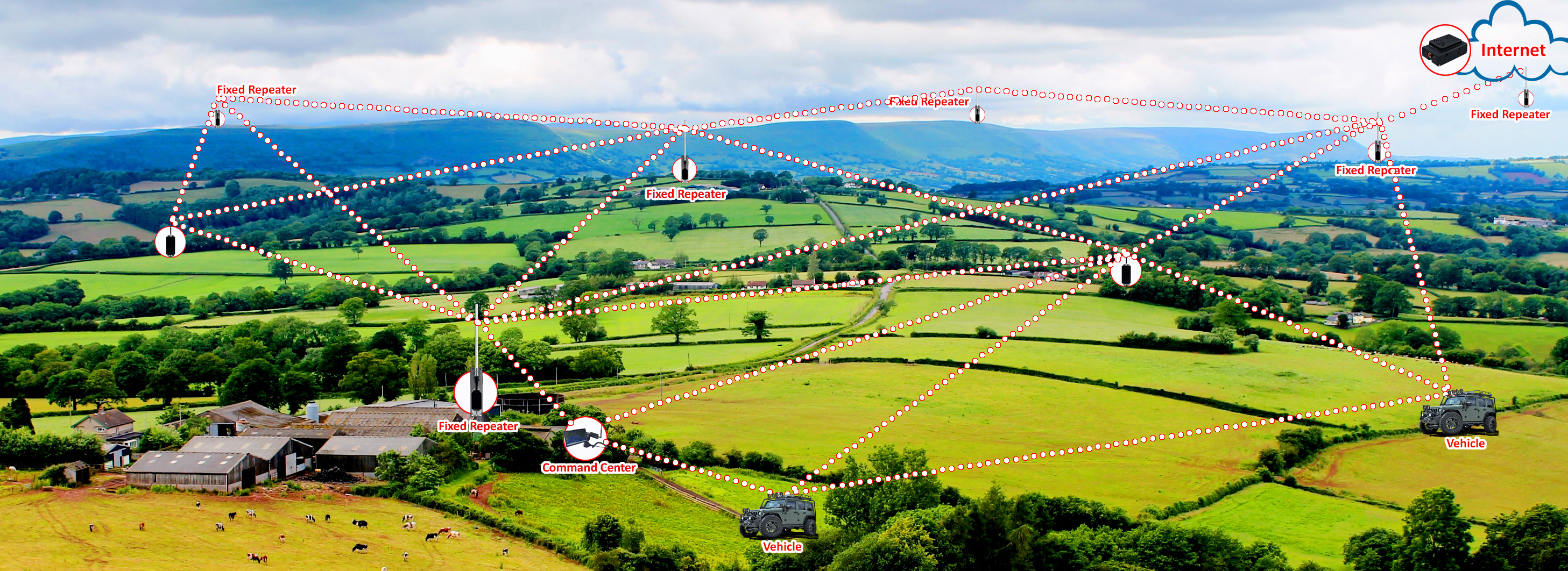 When a team arrives at a field site, the first thing they do is set up a command center. In this center, we set up the MU3 as a fixed radio station paired with a laptop or tablet. Next, we need to establish reliable communication coverage throughout the field site so that all team members can stay in touch in any situation. To this end, we will install MU3 devices with large, omnidirectional antennas in elevated locations. These devices will act as fixed repeaters and, depending on the terrain, will be able to provide coverage within a 20 km radius. The MU3s are made of aluminum and have an IP67 protection rating, so they will function reliably in any natural environment for an extended period. The powerful magnetic mounts included with the device allow it to be mounted on steel structures in seconds. Thanks to the mounting brackets, the device can also be quickly attached to masts or trees. Therefore, installing fixed repeaters will not take long. To cover areas that are difficult to reach by radio, such as reinforced concrete buildings or underground tunnels, we install additional MU3 devices with standard antennas, which provide a communication range of up to 3 km. This eliminates dead zones and allows all team members to stay in touch. On the team's vehicles, we install MU3 devices in the vehicle version, which will be powered by the vehicle's on-board power supply. Since all devices in the WAVESWAY network act as repeaters, the network's coverage area increases as vehicles move through the field site. Vehicles equipped with MU3 devices and roof antennas can communicate with each other up to 10 km away. As portable radios, team members can use special portable radios such as the MU7 or MU5, or the same MU3 devices, but in a portable version. This version comes with a MOLLE radio holder, as well as different types of headsets and antennas, depending on the tasks of the team members. All portable radios also act as repeaters, which extends the network's coverage area and eliminates dead zones, making the network more stable. Since the number of subscribers in the WAVESWAY network is unlimited, the main principle in organizing such a network is: "If you need to improve communication, just add a subscriber to the network". Additionally, WAVESWAY equipment enables collaboration with teams using different networks, such as DMR, Tetra, or P25. To accomplish this, the DE8026 cross-repeater can be used and installed in the coverage area of both networks. After installation, subscribers of these networks will be able to communicate with each other. WAVESWAY equipment can also connect our network to public networks, such as cellular networks or the Internet. To do so, additional MU3 repeaters must be installed to "reach" the area where these networks operate. We install an MS-2 network gateway there to broadcast radio network traffic to the public network and establish communication with headquarters anywhere in the world. Once these steps are complete, the WAVESWAY network will be fully operational. Depending on the size of the field site, setting up such a network takes anywhere from a few minutes to a few hours. Therefore, it's clear that the WAVESWAY network is one of the fastest deployable professional mobile radio networks in the world. It should also be noted that WAVESWAY networks based on MANET principles have no central nodes. WAVESWAY is a network in which every node is ready to receive and forward data to other nodes, where every node acts as a host and a router, an endpoint and a relay at the same time. Devices can move, join, or leave the network without affecting its overall performance. The network's algorithm quickly adapts to these situations by redirecting network traffic along the optimal route. This makes the network much more stable than other professional radio networks.
|